More than 2,000 years ago, the Greek mathematician Archimedes explained one of the simplest and most powerful ideas in mechanics: the lever.
The principle was straightforward. Give someone a long enough lever and a properly positioned fulcrum, and a relatively small force can move an enormous weight. Archimedes is famously associated with the statement, “Give me a place to stand, and I will move the Earth.”

The important insight was not that humans had suddenly become stronger. They hadn’t.
The architecture around the human had changed.
The lever multiplied what a person could accomplish.
Human history can be understood, in part, as the continuing search for better levers.
Agriculture gave us leverage over food production. Machines gave us leverage over physical labor. Steam engines and electricity gave us leverage over energy. Industrial organizations gave us leverage through coordination and scale. Computers gave us leverage over calculation. Networks gave us leverage over communication and connectivity.
Now artificial intelligence is giving us leverage over something different: intelligence itself.
This is one of the defining characteristics of what I call the Sixth Great Transition.
For most of human history, intelligence was scarce, expensive, local and overwhelmingly human. If an organization wanted more analysis, writing, planning, design, problem-solving or decision support, it generally needed more people with the necessary knowledge and experience.
That assumption is changing.
Machine intelligence can increasingly analyze information, generate ideas, write software, create content, recognize patterns, coordinate activities and operate systems. One human working with intelligent machines may soon be able to accomplish things that once required dozens, hundreds or even thousands of people.
We are building an extraordinarily long lever.
But Archimedes’ lesson contains something else that deserves our attention.
A lever requires a fulcrum.
Where you place that fulcrum determines what happens when force is applied. The same is true of technology. Artificial intelligence does not determine its own purpose. People, organizations and institutions decide where it is deployed, what it is optimized to accomplish, what authority it receives and what boundaries surround it.
That makes leadership increasingly important, not less.
When intelligence becomes abundant, the central leadership question shifts from simply, “What can we do?” to “What should we do?”
Capability is not purpose.
Intelligence is not wisdom.
And intelligence does not confer moral authority.
The more powerful our technological leverage becomes, the more important human judgment, ethics, responsibility and stewardship become.
This is why one question runs through my book, The Future of Human Leadership: When Intelligence Is Everywhere:
“Whom do I serve?”
It is a deceptively simple question. But it forces us to think about the purpose toward which all this extraordinary capability is being directed.
Are we using our new leverage simply to make organizations faster? To reduce costs? To automate more work? To increase profits? Those may all be legitimate objectives. But they are incomplete answers.
The larger question is whether the systems we create ultimately help people, organizations, societies and ecosystems flourish together.
Archimedes taught us how a small force could move an enormous object.
The Sixth Great Transition gives us increasingly powerful technological levers of our own.
The challenge for this generation of leaders is deciding where to place the fulcrum, who controls the lever, what we intend to move—and, ultimately, whom all that power is meant to serve.
The backstory begins with something I kept hearing: “We’re doomed.”

In conversations people kept expressing the same concerns that artificial intelligence is moving too fast, it’s taking our jobs, and it will ultimately kill us all!”
What bothered me the most was the sense of helplessness underneath it all. People were talking as though the future had already been decided, and all we could do was wait to find out how bad it would be.
I found myself asking, “If this is the case, who is doing this to us?” And the uncomfortable answer was: we are.
Humans are developing these technologies, funding them, choosing their purposes, and deciding how to use them. We don’t all have equal power, and nobody controls the whole process. But human decisions are shaping this future. That means we still have responsibilities, and we still have choices.
Read more…What I’m saying in this book is that our ability to change the world is growing faster than our ability to understand and govern the consequences. We’re gaining extraordinary capabilities through artificial intelligence, science, and technology. I want us to use those capabilities to solve difficult problems and improve lives. But we also have to ask: What are we trying to accomplish? What kind of future are we using all this intelligence to build?

For me, that begins with a personal question: “Whom do I serve?” We can become so focused on increasing productivity, reducing costs, and meeting our targets that we lose sight of what those achievements are ultimately supposed to make possible. I believe our purpose should be Flourishing Together. That means our families doing well, our organizations succeeding, our communities becoming healthier, and the living systems around us remaining capable of supporting life. That is a future worth working toward.
Once we choose that purpose, it changes how we think about leadership. Every decision we make helps create conditions that other people have to live and work within. We influence whether people understand what is happening, whether they have a voice, whether they belong, and whether they can see a meaningful place for themselves in the future. If we want people to bring judgment, creativity, empathy, and responsibility to their work, we have to protect the conditions that allow those capacities to develop and contribute.
We also have to look beyond the immediate result. An organization can report success while exhausting its people, weakening its community, or passing costs to future generations. So we need to ask who benefits, who carries the burden, and what remains possible afterward. Difficult tradeoffs will always be part of leadership. Our responsibility is to face them honestly, listen to the people affected, and remain willing to change course as we learn.
Ultimately, I’m asking us to take responsibility for the future our decisions are helping create. We won’t control everything, but we can influence the purposes our technologies serve, the authority we give them, and the conditions we leave for others. I want our children and grandchildren to look at what we built and find opportunities to live well, contribute, and make their own choices. That is how I believe leadership should be measured: by what we accomplish today and what we leave others capable of becoming.
Amazon’s link to the book, https://a.co/d/07P5cAt0
Telos is an ancient Greek word meaning end or purpose. Aristotle thought that to understand anything fully, we have to ask not only what it does, but what it’s for. That question sits very close to the philosophy in my new book, “The Future of Human Leadership”.
Today we have astonishing and fast growing capabilities. We can analyze faster and automate almost anything, but telos asks toward what? Capability answers “can we?”, while telos asks “should we, and for whom?” That’s why my book’s guiding principles, flourishing together and whom do I serve, really matter. They provide a direction, a reason beneath the speed.
Aristotle thought that the highest telos for humans was flourishing. Today we face the same question at a civilizational scale. What is all this intelligence ultimately for? In an age of abundant capability, telos reminds us that purpose is not optional, it is the point.

The world is racing to build smarter artificial intelligence. We want AI that can think, plan, decide, and act autonomously. We want machines that can do more work, solve more problems, increase profits, and make organizations more efficient.
But there is a question we should ask before we go much further:
Whom do we serve?
Why are we building all of this intelligence and automation? What is the destination we are all running toward?
Making things faster is not the destination. Cutting costs is not the only destination. Increasing profits for shareholders is not the ultimate destination. Even creating more powerful AI to stroke our egos is not the destination.
These are tools and means. They are not the reason for the journey.
The goal, I believe, should be Flourishing Together.
That means using our growing intelligence—human and machine—to help people, organizations, societies, and the natural world flourish together.
This does not mean everyone always wins. Hard choices will still have to be made. But it does mean we should think carefully about who benefits from our decisions, who pays the price, and what kind of future those decisions are creating.
The central argument of my new book, The Future of Human Leadership is that humanity has entered a historically significant transition in which capability is expanding faster than people and institutions can understand, govern, or absorb it. Artificial intelligence is an important part of this change, but the transformation is much larger than AI. Science, technology, society, geopolitics, economics, philosophy, and the environment are changing simultaneously and interacting with one another. I describe this convergence as the Sixth Great Transition. Its defining characteristic is not one invention or technology, but the redistribution and expansion of intelligence, perception, decision-making, and action across humans, machines, networks, institutions, and living systems.

The institutions we inherited were designed around an assumption that is becoming increasingly unreliable: somewhere in the system, a capable human being would have enough information, time, understanding, and authority to recognize what was happening, make sense of it, intervene when necessary, and accept responsibility for the result. Modern organizations still depend heavily on this assumption even as the operating environment moves beyond human scale. Information can circulate faster than people can verify it. Machines can analyze and act before people fully understand the situation. Consequences can spread across highly connected systems before formal authority has time to respond. At the same time, leaders face eight New Operating Conditions—Acceleration, Temporal Compression, Consequence Compression, Distributed Intelligence, Persistent Connectivity, Growing Interdependence, Continuous Exposure, and Compounding Complexity. These conditions greatly expand what organizations can accomplish, but they also make responsible leadership more difficult.
A major consequence is that organizations can exceed human limits while still appearing successful. People may remain productive while Judgment deteriorates, attention fragments, trust weakens, and their ability to understand what is happening declines. Technology may increase organizational capacity without increasing the human capacity required to govern it. This is why the book argues that human limits should not simply be treated as weaknesses to overcome through additional pressure. They are design realities. Human beings require certain conditions if they are to remain capable participants in increasingly complex systems. I identify six Human Viability Conditions: Coherence, Agency, Belonging, Fairness, Meaning, and Identity Continuity. When these conditions deteriorate, the deeper Human Capacities organizations increasingly need—Judgment, Ethics, Empathy, Creativity, Narrative, and Relational Trust—also become harder to exercise. Meaningful transformation consumes finite adaptive energy as people reconstruct skills, roles, routines, relationships, and identities. Leaders therefore cannot assume that every technically possible transformation is humanly absorbable.
Protecting people, however, is not the book’s final objective. The larger purpose is what I call Flourishing Together. Leadership decisions must be evaluated according to what they create not only for an organization, but for People, Organizations, Societies, and Ecosystems. These interests will not always align, and leadership will continue to require difficult tradeoffs. Flourishing Together does not mean avoiding conflict or ensuring that every decision benefits everyone equally. It means making consequences visible, refusing to hide costs by transferring them elsewhere, and ensuring that success in one part of the system is not purchased through the long-term degradation of another. Leadership is ultimately responsible not only for immediate performance but for the conditions its decisions leave behind.
To govern this emerging world, leaders must learn to operate within what I call Polyintelligence: the coordinated presence of Human, Machine, and Ecological Intelligence. Each sees and contributes something different. Human Intelligence brings Judgment, Ethics, Empathy, Creativity, Narrative, Relational Trust, Meaning, legitimacy, and responsibility. Machine Intelligence greatly expands speed, scale, memory, monitoring, simulation, retrieval, repetition, and pattern recognition. Ecological Intelligence reveals interdependence, thresholds, regeneration, resilience, physical limits, and consequences unfolding over long time horizons. The goal is not to determine which intelligence is universally superior. The leadership challenge is to orchestrate them—assigning each to the work it can perform well while ensuring that capability does not quietly acquire authority simply because it can act.
This distinction becomes increasingly important as systems move from assisting people to acting autonomously. Human oversight cannot be meaningful if people are inserted into a process only after the important choices have already been made. Authority must exist where someone can understand enough of the situation, act while action still matters, change or stop the result, and remain accountable for the consequences. As autonomy increases, human leadership often moves “above the loop.” Leaders exercise responsibility by determining purposes, permissions, boundaries, escalation conditions, stopping mechanisms, verification requirements, and avenues for repair and appeal before autonomous systems begin operating. Operational autonomy can be delegated; moral responsibility cannot simply disappear.
The same redesign is required around time. Human beings, digital systems, inherited historical assumptions, and future consequences operate according to different clocks. Maximum speed is therefore not always the correct objective. Leadership must manage tempo—deciding what should accelerate, what requires deliberation, where pauses protect the system, and whether mechanisms for detecting and correcting mistakes can keep pace with mechanisms for producing action. Organizations must become better sensing systems, capable of noticing weak signals and uncomfortable evidence before options disappear. This leads to Decision Viability: bringing trustworthy knowledge, legitimate authority, usable capability, coordination, and sufficient time together while a meaningful choice still exists. A perfectly reasoned decision that arrives after the opportunity to act has disappeared is not operationally viable.
Responsible leadership also requires learning, maneuver, preparedness, and resilience. Organizations must do more than produce lessons-learned reports; consequences must return to the system and change future behavior. They must preserve enough flexibility to maneuver when assumptions fail rather than becoming trapped by yesterday’s successful plans. They must rehearse uncertainty through scenarios and possibility chains, not because the future can be predicted perfectly, but because preparation improves the ability to recognize, coordinate, question, improvise, and respond. Resilience must also be measured across the longer loop. Surviving one disruption by exhausting people, consuming reserves, weakening relationships, or sacrificing future capacity is not genuine resilience. Leadership must leave the system capable of facing what comes next.
This changes the question of human value in an age of increasingly capable machines. The future of human contribution should not be defined by searching for a shrinking collection of tasks that machines cannot perform. That allows technology to define human purpose by subtraction. Instead, leaders and societies must decide deliberately what forms of human contribution they value. As machine capability expands, Judgment, Ethics, Empathy, Creativity, Narrative, Relational Trust, responsibility, and Meaning become more important precisely because more intelligence creates more possibilities and therefore more consequential choices. The human role is not simply to compete with Machine Intelligence. It is to help determine what expanding intelligence is for.
The book therefore ends where leadership ultimately begins: with stewardship. Leaders temporarily inherit institutions, technologies, relationships, resources, responsibilities, and possibilities that will eventually pass to others. Their success cannot be measured only by what happened during their tenure. It must also be measured by what remained possible afterward: whether people retained Agency and Judgment, whether the institution became better at seeing reality, whether authority remained legitimate, whether learning and resilience increased, and whether future leaders inherited meaningful freedom to choose.
The Sixth Great Transition is underway, but its destination has not been determined. Technology does not decide what kind of future humanity will inhabit. The purposes leaders choose, the intelligence they orchestrate, the authority they grant, the limits they respect, the truths they are willing to hear, and the conditions they leave behind will help determine that future. This is why the deepest leadership question in the book is not “What can we do?” or even “What should we do?” It is: “Whom do I serve?”
That question is the moral center of The Future of Human Leadership. When intelligence is everywhere, leadership becomes less about being the source of intelligence and more about governing intelligence wisely. The future of Human Leadership is therefore fundamentally a question of Judgment, responsibility, stewardship, and the deliberate creation of conditions in which people, organizations, societies, and ecosystems can Flourish Together.
The complete book, The Future of Human Leadership: When Intelligence Is Everywhere is available here.

Human history can be understood as a long transfer of burden and capability. For most of our existence, what humanity could accomplish was limited by the capabilities of the human body. We could carry only so much, travel only so fast, work only so long, and remember only so much. Then we began moving those limitations outside ourselves.
We supplemented human muscle with animal muscle. Oxen pulled our plows, horses carried us farther and faster, and wind and water turned our mills. Humans still supplied purpose, direction, and judgment, but we had begun externalizing physical capability. Steam dramatically accelerated the process. Enormous amounts of mechanical power could now be generated without muscles at all, powering factories, locomotives, ships, and mines. Human beings increasingly became operators of power rather than its primary source.
Electricity took the next step. Steam had concentrated power; electricity distributed it. Energy could travel through networks and appear wherever it was needed. Petroleum and the internal-combustion engine distributed mechanical power even further through cars, trucks, tractors, airplanes, and construction equipment. Something profound was happening: capability was becoming detached from the individual person.
Then computers moved this same process from our muscles toward our minds. Computers externalized calculation, memory, information processing, and control. Tasks that once required human cognitive effort could increasingly be performed by machines. Eventually, billions of people carried networked computers in their pockets, providing almost instant access to information, navigation, communication, and computational power. We had entered the age of cognitive industrialization.
Read more…Disclaimer: I’m no expert in world religions, traditions, theologies, philosophies or doctrines. The point of this article is not to judge, but to highlight the fact that many of us have grown up in traditions that may influence our perspective of the future in many different and interesting ways. It is important to recognize that we are not all starting with a clean slate when we study the future.
Views on Destiny
Let’s begin by exploring how doctrines, traditions, philosophies and religious beliefs might give us unique worldviews about the future and our destiny. I use the term Doctrinal Future Time: to describe the future as it has been taught, promised, warned about, or morally structured by various traditions and philosophies.
As a reminder, Historically Imagined Time gives us an imagined story about where we came from. Doctrinal Future Time gives us a story about where everything is going. The Vices of Foresight are the lenses many of us wear that can distort our views of the emerging future.
These influences create a powerful combination that can impact our perceptions of the future, and because of that a person may not approach the study of our emerging future as genuinely open for debate and inquiry.
Read more…Futurists and business leaders spend enormous amounts of time trying to improve the quality of their information. We study weak signals, emerging technologies, demographic shifts, economic trends, geopolitical risks, consumer behavior, and scientific breakthroughs. We build scenarios, hire experts, analyze data, and increasingly ask artificial intelligence to help us recognize patterns that humans might miss.
But there is another variable sitting quietly inside every forecast: the personality of the person doing the forecasting.

We tend to assume that when two intelligent people look at the same evidence and reach very different conclusions about the future, one of them must have misunderstood the evidence. Sometimes that is true. But personality research suggests something more interesting may also be happening. People may be psychologically inclined to notice different kinds of evidence, tolerate different levels of uncertainty, prefer different time horizons, and imagine different ranges of possibility.
That makes personality another important lens through which we see the future.
Read more…Foresight is often mistaken for prediction. We imagine its purpose is to tell us what will happen next: which technology will win, which market will emerge, which threat will become serious, or which opportunity will matter most. But prediction and foresight are not the same thing.
The Future is Many Possibilities
Prediction asks, “What will happen?” Foresight asks a different set of questions: What is changing? What might follow? What assumptions are beginning to weaken? And is our current understanding of the world still good enough to guide our decisions?
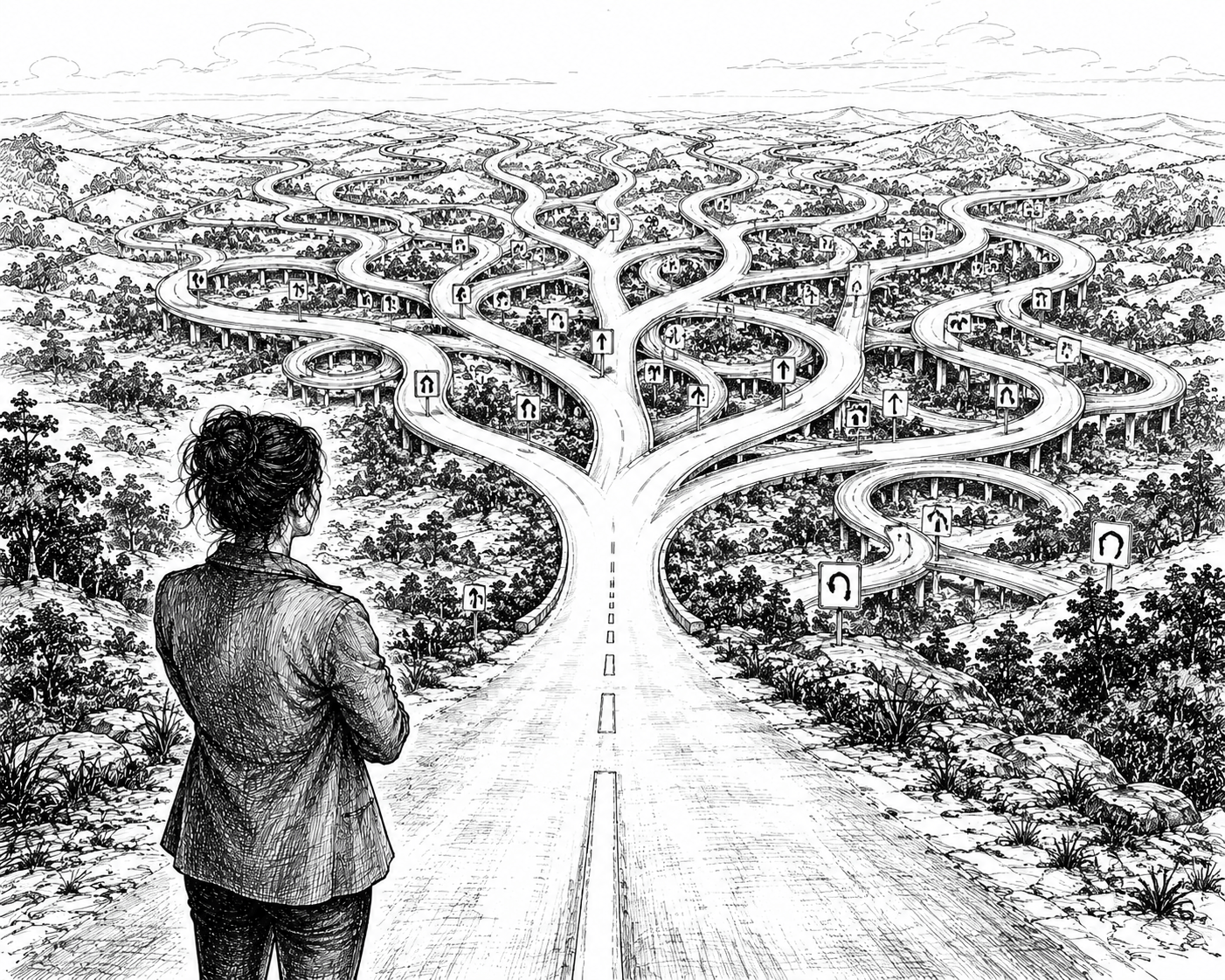
Frank Diana recently wrote a great article where he explains this in detail.
Prediction seeks an answer. Orientation points us in a direction and preserves the ability to revise.
That distinction matters because the future rarely announces itself through one decisive fact. More often, it appears gradually through weak signals, anomalies, changing relationships, unexpected combinations, new behaviors, and shifts in what people value. Leaders must assemble these fragments into a working understanding of what may be emerging without pretending that the picture is complete.
Read more…